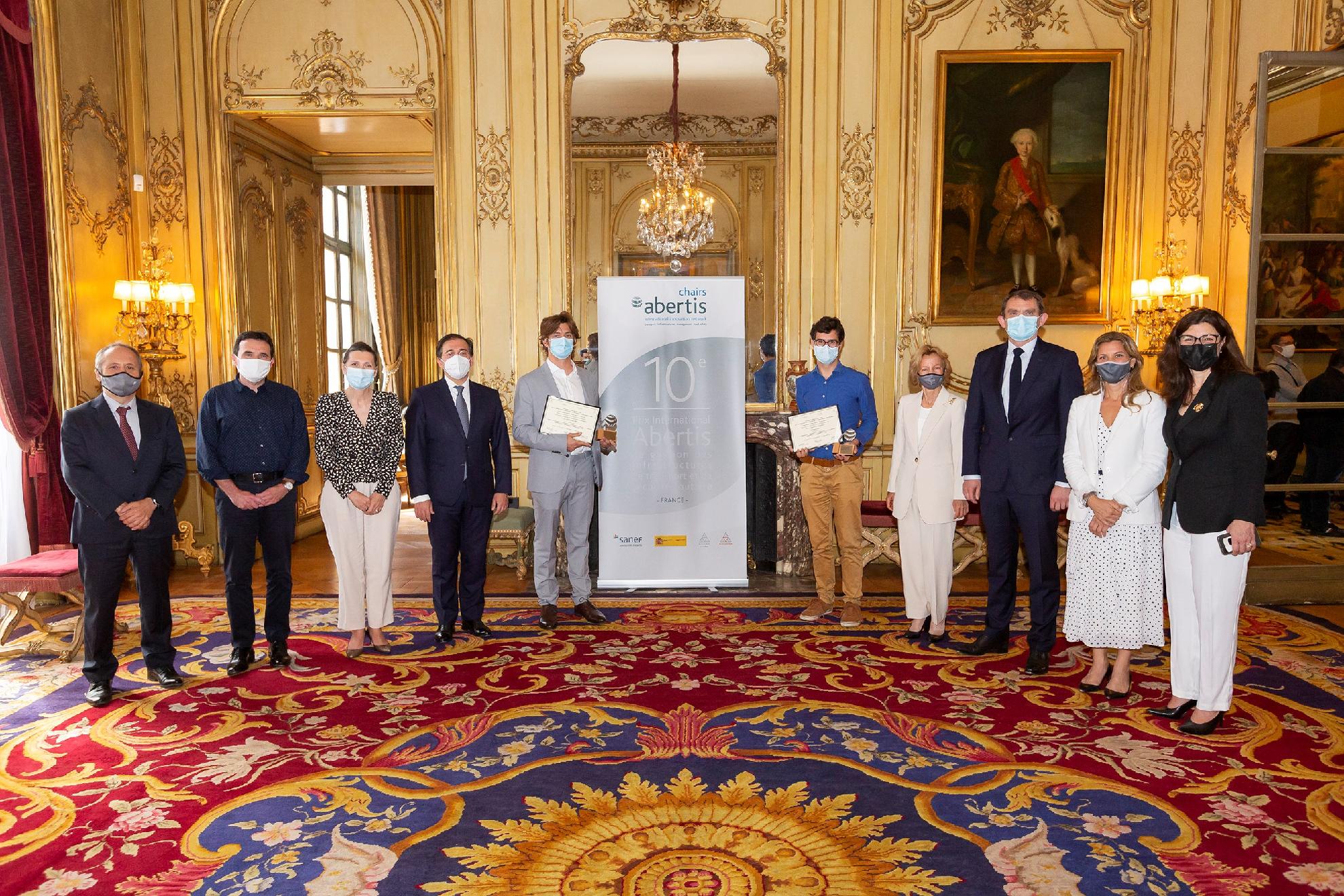
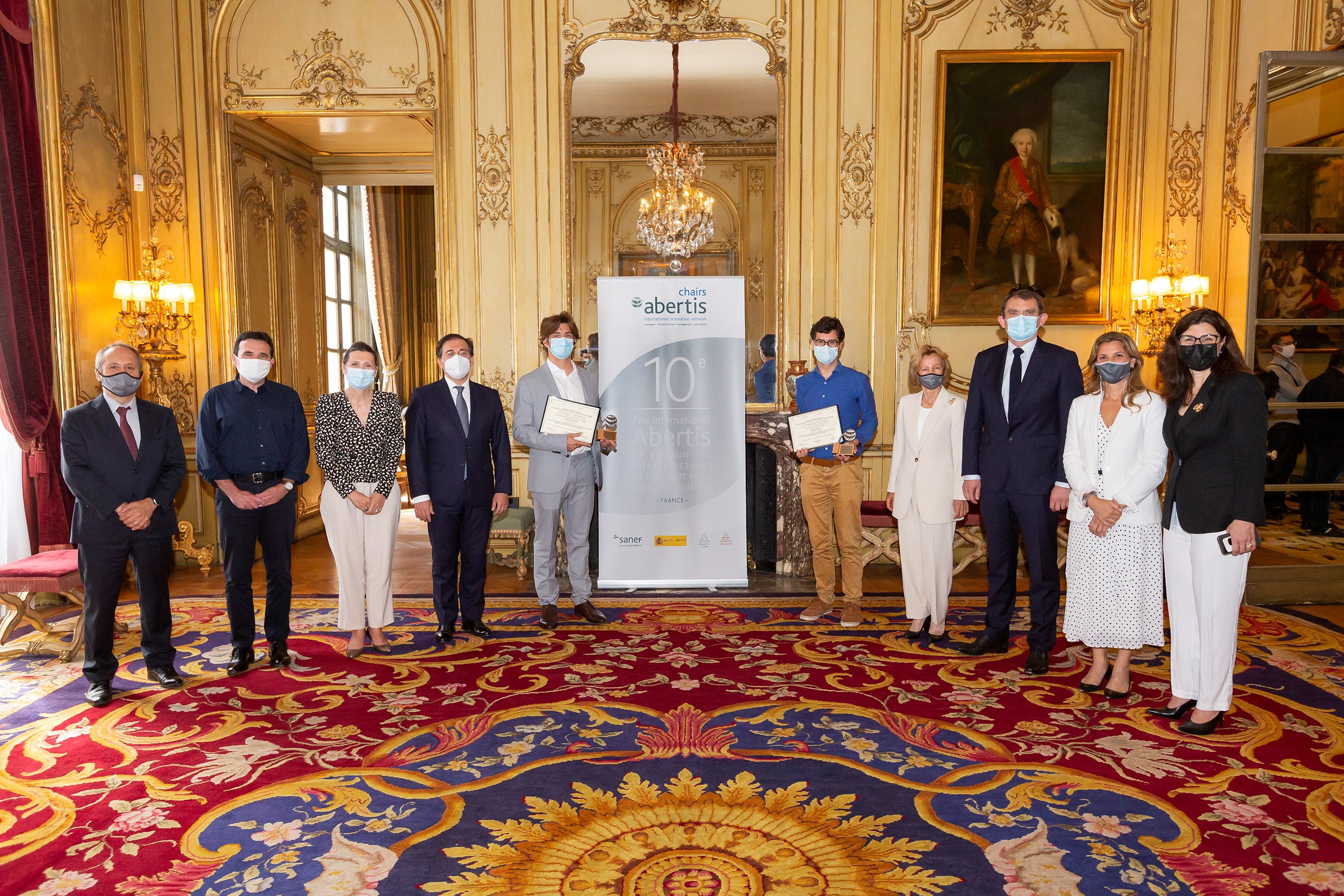
The Abertis Chair, from the International Innovation Network of Abertis Chairs, has delivered this morning the Abertis Awards for the Management of Transport Infrastructures and Road Safety of the Abertis-Sanef-École des Ponts Chair, which recognize annually the best final degree projects or doctoral theses of French university students in its two categories: Management of Transport Infrastructures and Road Safety.
The first prize in the category of Transport Infrastructure Management went to Dr. Leo Mendiboure from the University of Bordeaux, for his doctoral thesis Distribution géographique de données dans l'Internet des Véhicules: une approche logicielle et securisée utilisant les réseaux cellulaires.
In the Road Safety category, the winner was Dr. Edouard Leurent from the University of Lille, for the doctoral thesis Apprentissage par enforcement sûr et efficace pour la prize de décision comportementale en conduite autonome.
Each of the prizes has a financial prize of € 7,000.
The awards ceremony took place at the Residence of the Spanish Ambassador in Paris and was attended by the Hon. Ambassador of Spain, José Manuel Albares; the president of the Abertis Foundation, Elena Salgado; the CEO of Sanef, Arnaud Quémard and the director of l’École des Ponts, Sophie Mougard.
The Abertis-Sanef-École Ponts Chair is part of the International Innovation Network of Abertis Chairs, with similar awards in Spain (where the first chair was founded in 2003), Chile, Brazil and Puerto Rico, always in collaboration with leading universities in each of the countries. From all of them, the Abertis International Award arises annually, in which the two winners from each country participate and among all of them, the respective winner is chosen in each of their categories.
The Abertis Chairs, to promote academic innovation
Aware of the importance of linking with the academic world for social and economic progress, Abertis promotes training, research and the transfer of knowledge between the University and the Company.
Through the International Network of Abertis Chairs, the aim is to stimulate and support university students to generate and disseminate new knowledge and innovations in the respective fields of activity, putting them at the service of the entire society and the technical and educational community and caring for and helping students talent that universities are able to bring out and channel.
The network of Abertis Chairs is made up of those established in Spain (Polytechnic University of Madrid and Polytechnic University of Barcelona, BarcelonaTech), France (École des Ponts-ParisTech), Puerto Rico (University of Puerto Rico), Chile (Pontificia Universidad Católica de Chile) and Brazil (University of São Paulo).
22 September 2026
• The Group, together with its Foundation, has opened applications for the Safe Road Operations Challenge, a new open innovation call aimed at technology startups and SMEs from around the world.
• According to the Spanish Directorate-General for Traffic's National Registry of Traffic Accident Victims, 154 accidents related to road maintenance and conservation work were recorded on Spanish roads in 2025, with speed being the main risk factor.
• The challenge addresses a risk common to road operations worldwide: the direct interaction between road workers, live traffic and changing operating conditions.
• The winning proposal will receive a €40,000 ...
15 June 2026
• This is one of the main findings of a study conducted by Universidad Politécnica de Madrid (UPM) in collaboration with the TRANSyT Transport Research Centre, and promoted by the Abertis Foundation as part of its international Chairs programme, analysing mobility habits, infrastructure assessments and future expectations.
• 77% of users believe toll roads have better pavement conditions than non-toll roads, and 67% say they feel safer driving on them.
• 85% call for real-time information on accidents and roadworks to be available directly in vehicles, while 75% support expanding barrier-free payment systems.
• 74% say they would use motorways more if they had access to a free electronic payment device, and seven out of ten already use mobile apps to plan their journeys.