
A report released today by The Economist Intelligence Unit and commissioned by Abertis found that new road technologies are transforming transport – and hold the key to a cleaner, safer and smarter mobility future.
Global traffic is growing as economies around the world expand. But that growth brings economic and social challenges – like the lost productivity associated with gridlock, deaths from accidents on the road, air pollution, and climate change.
Connected, autonomous, and electric cars are becoming a reality, and could tackle some of those challenges. But we won’t unlock their true potential unless innovation in road infrastructure keeps pace with the advances in vehicle technologies. Road Tech can be the platform for the future of mobility, as both the road surface and infrastructure are redefined to include digital components, wireless networks and sensors, and electric vehicle charging technology.
A cleaner, safer and smarter mobility future
Abertis CEO and Vice Chairman Francisco Reynés commented: “At Abertis we believe that tackling the challenges of global traffic growth means working at the intersection of technology advances and road infrastructure innovation. That is why we commissioned this report, to develop the most comprehensive overview of the technologies and innovations coming through – and to establish what’s needed to accelerate their adoption”.
‘Road Tech: Addressing the challenges of traffic growth’, released today in Barcelona, is based on in-depth interviews with leading experts from infrastructure, tech and transport experts across sectors and geographies. The report is part of the company’s long-term commitment to create a smarter, cleaner and safer mobility future, by working in partnership with governments and innovators to accelerate new technologies and realise their full potential.
Detailed findings of report
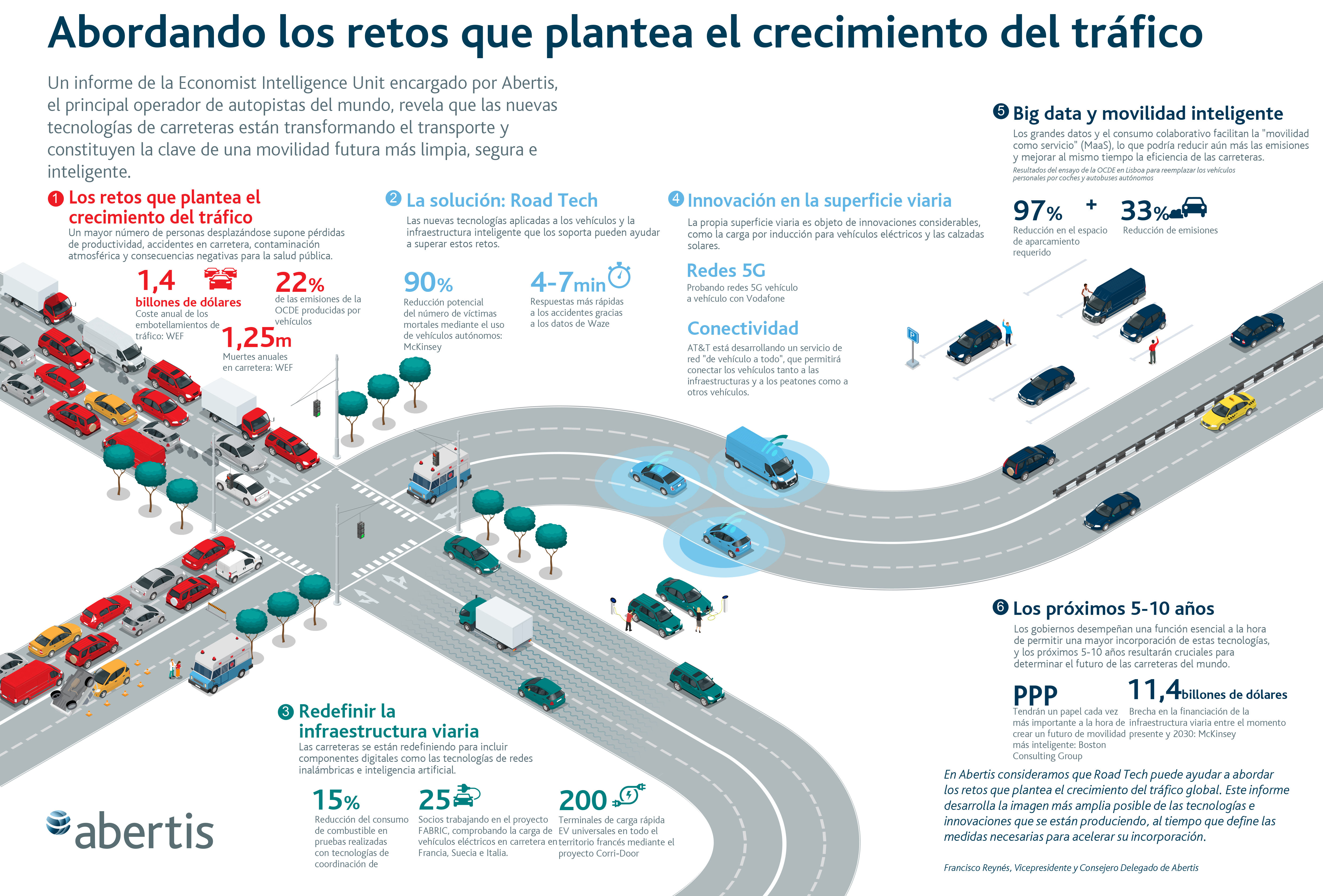
Growing traffic is resulting in productivity losses, road accidents, air pollution and an adverse impact on public health.
New road technologies give us the chance to overcome some of these challenges.
That’s why road infrastructure is being redefined to include digital components like wireless network technologies and AI.
Big data and the sharing economy are facilitating “mobility as a service” (MaaS), which could further reduce emissions while increasing road efficiency.
The road surface itself is the focus of considerable innovation, like inductive charging for electric vehicles and solar roads.
Governments have a pivotal role to play in enabling greater adoption of these technologies – and the next 5-10 years will be crucial in determining the future of the world’s roads.
Download full Road Tech Report
Know more about Abertis' Road Tech program
15 June 2026
• This is one of the main findings of a study conducted by Universidad Politécnica de Madrid (UPM) in collaboration with the TRANSyT Transport Research Centre, and promoted by the Abertis Foundation as part of its international Chairs programme, analysing mobility habits, infrastructure assessments and future expectations.
• 77% of users believe toll roads have better pavement conditions than non-toll roads, and 67% say they feel safer driving on them.
• 85% call for real-time information on accidents and roadworks to be available directly in vehicles, while 75% support expanding barrier-free payment systems.
• 74% say they would use motorways more if they had access to a free electronic payment device, and seven out of ten already use mobile apps to plan their journeys.
21 May 2026
The Abertis Foundation has presented the Abertis Spain 2026 Awards, which recognise research excellence in sustainable mobility, infrastructure and transport, in an edition that also marks the beginning of a new stage of the Abertis Chairs International Network, which is consolidating itself as an international mobility observatory.
The Abertis Chairs International Network, coordinated by the Universidad Politécnica de Madrid (UPM), promotes collaboration between some of the most prestigious universities in the countries in which Abertis operates, to promote sustainable mobility through data analysis, applied research and the development of innovative projects.
The event, held as part of a day of debate on road infrastructure, brought together experts from academia, business and institutions to address issues such as innovation, digitalisation, user experience and financing models.