
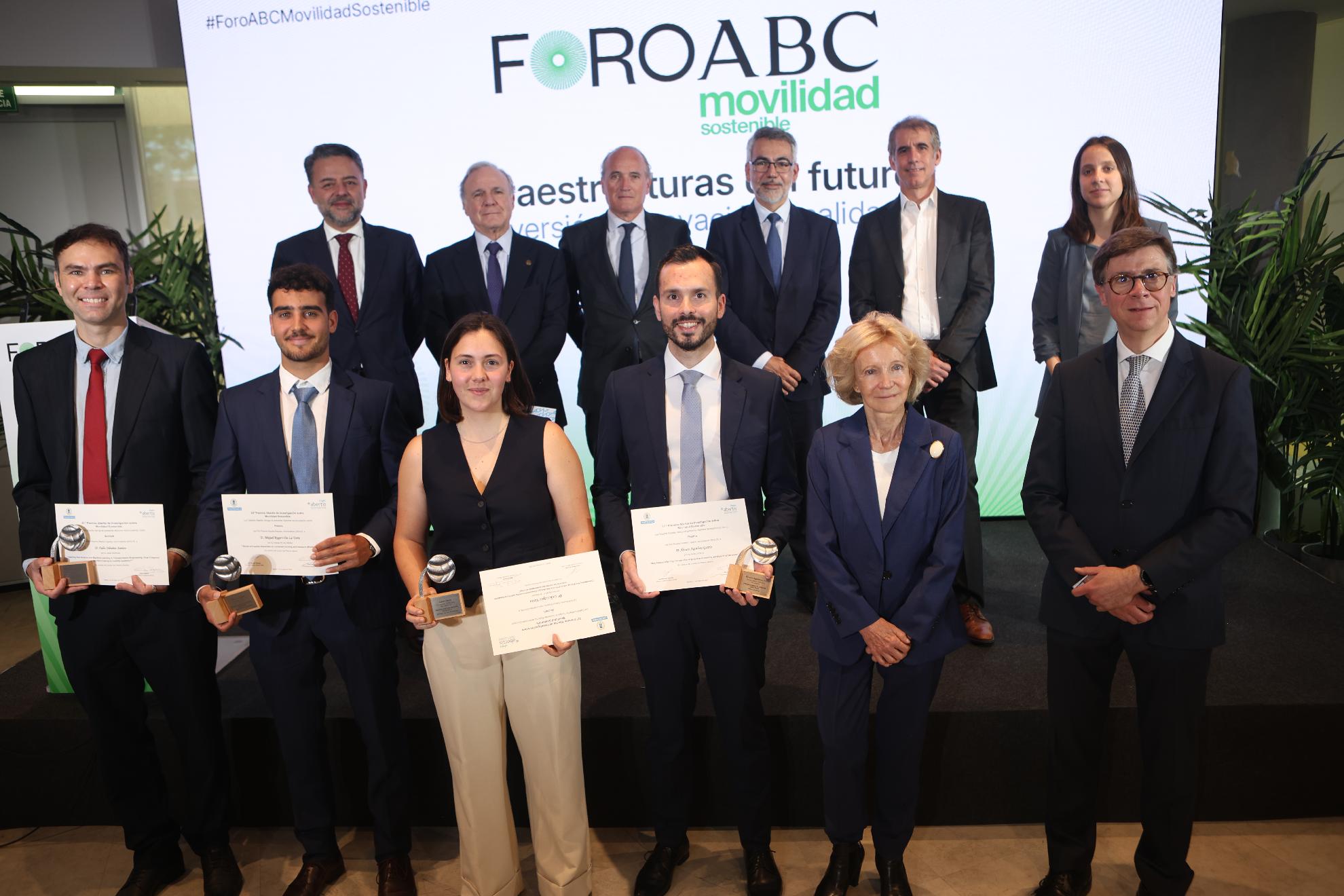
The Abertis Foundation has presented the Abertis Spain 2026 Awards, which recognise research excellence in sustainable mobility, infrastructure and transport, in an edition that also marks the beginning of a new stage of the Abertis Chairs International Network, which is consolidating itself as an international mobility observatory.
The Abertis Chairs International Network, coordinated by the Universidad Politécnica de Madrid (UPM), promotes collaboration between some of the most prestigious universities in the countries in which Abertis operates, to promote sustainable mobility through data analysis, applied research and the development of innovative projects.
The event, held as part of a day of debate on road infrastructure, brought together experts from academia, business and institutions to address issues such as innovation, digitalisation, user experience and financing models.
Madrid, 21 May 2026.- The Abertis Foundation today held the Abertis Spain 2026 Awards ceremony, with the aim of recognising the academic excellence of the best doctoral theses and master's theses in transport infrastructure management, road safety and sustainable mobility.
This year's edition represents the starting point of a new stage of the International Network of Abertis Chairs, with a biennial award scheme from 2026, which will allow the development of works of greater breadth and depth.
The event, part of a day of debate and reflection on the mobility of the future, brought together representatives from the academic, business and institutional spheres to reflect on the major challenges in road infrastructure in a context marked by technological transformation, and the transition towards more digitalised, sustainable, connected, efficient and user-experience-oriented models.
A new model of Chairs
During the opening of the meeting, the president of the Abertis Foundation, Elena Salgado, highlighted the trajectory of the Abertis Chairs, created in Spain in 2003 with the aim of promoting the transfer of knowledge between universities and companies and contributing to better management of transport infrastructures.
Currently, the Abertis Chairs International Network– coordinated by the Universidad Politécnica de Madrid (UPM) – integrates seven leading universities from different countries where the Abertis Group operates, has nearly 900 researchers and students of 15 nationalities and has recognised more than 300 research works since its creation.
Salgado underlined the change of model, aimed at consolidating the Abertis Chairs International Network as an international observatory of sustainable mobility and promoting pilot projects such as the analysis of the perception of sustainability and quality of service of road infrastructures, incorporating the “This new approach, which frames the Network as a mobility trends observatory, strengthens partnerships between academia and industry, drives impactful research initiatives, and consolidates a global, people-focused vision of sustainable mobility and service excellence in Abertis’ countries of operation”, highlighted Elena Salgado.
Along these lines, during the last year a survey was launched in Spain, Italy and Brazil to analyse the perception of users about toll roads, the results of which were integrated with the historical satisfaction data collected by the Network.
Study on the use of motorways in Spain promoted by the Abertis Foundation and the UPM
During the conference, the coordinator of the Abertis Chairs Network, José Manuel Vassallo, presented the results of the survey launched in 2025 on the user experience in toll infrastructures for Spain.
The study, based on a sample of almost 1,700 toll road users in Spain, allows us to draw an X-ray of the preferences and demands of drivers. In general terms, it reveals a majority profile of intensive users (67% use them at least once a month), with an average age of 44 years and a growing demand in terms of digitalisation, sustainability and tariff equity.
Among the main results of the assessments on the quality of toll roads, it stands out that users particularly valued the lower congestion, the better condition of the pavement, the safety and maintenance of toll roads compared to other road infrastructures. In this sense, areas for improvement have also been identified such as services on the road (40%), that is, in rest areas, petrol stations or restaurants.
Also noteworthy as options for improvement are the need to strengthen real-time information on journeys (24%) and assistance in the event of accidents or breakdowns (23%), together with improvements in signage and the increase in rest areas for professional hauliers.
On the other hand, among the main demands for the future, users are once again prioritising measures for the transmission of information in real time in the vehicle, barrier-free payment systems, dynamic traffic management and the deployment of infrastructures adapted to electric and autonomous vehicles.
Other of the most relevant conclusions of the study are related to the method of payment of the toll. The current low level of adoption of electronic payment devices is evident, which is only used by 21% of respondents. However, the potential for growth is high, with 74% of users saying they would use the motorway more if they had a free electronic device, highlighting the ability of these systems to drive demand.
In the field of environmental sustainability, users show clear support for measures that encourage more responsible behaviour, valuing, in particular, discounts for vehicles with more than two occupants (70% support), for less polluting vehicles (59%) and the restriction of heavy vehicles at peak times (56%).
Finally, in terms of social sustainability, users support measures aimed at equity and economic savings, including discounts for frequent users (87%), bonuses for people with low incomes or residents in rural areas (76%) and the implementation of flat rates for unlimited use (73%).
In conclusion, the study shows that motorway users in Spain demand an evolution of the model based on three key axes: accessible digitalisation of payment, incentives for environmental sustainability and greater equity in tariffs, together with continuous improvement in the quality of service. These factors will be decisive in strengthening the use of motorways and the positive perception of the system in the future.
Abertis Spain Awards Ceremony 2026
The day concluded with the presentation of the Abertis Spain 2026 Awards, which recognise research excellence in sustainable mobility, infrastructure and transport.
Among the winners of doctoral theses are Álvaro Aguilera, from the Universidad Politécnica de Madrid (UPM), for his study "Key factors that influence the use of emerging shared mobility services in urban areas", and Tulio Silveira, also from the U.P.M. for their study "Application of Data Science and Machine Learning to Transportation Engineering: Does It Improve Decision-Making in Mobility Systems?"
On the other hand, in the category of master's projects, the winners were Miquel Roger de la Torre, from the Universidad Politécnica de Catalunya, for "Social and spatial disparities in the combined affordability of housing and transport" and Celia López Yarza, also from the U.P.C. – "Considering the diverse value of time in the design of inclusive mobility solutions based on cooperative connected automated vehicles".
About the Abertis Chairs International Network
The Abertis Chairs International Network promotes applied research, innovation and knowledge transfer in sustainable mobility and infrastructure management, connecting university work with real challenges in the sector and promoting academic excellence through its awards and research programmes.
About the Abertis Foundation
The Abertis Foundation was created in 1999 with the aim of contributing to the sustainable development of the territories where the Abertis Group operates. The entity promotes initiatives related to road safety, environmental sustainability, social action and culture, promoting social impact projects and collaborations with universities and international institutions.
5 October 2026
• The agreement includes a €1.4 million contribution for a new three-year period, extending the joint project launched in 2017. The partnership has already benefited more than five million children and adolescents.
• This renewed partnership will focus its activities on two countries where the Foundation is present: Brazil and Mexico.
o In Brazil, the project will promote safe mobility by ensuring safe access to rights and essential services in vulnerable urban areas.o In Mexico, the STEM project will continue to promote science-related subjects among girls and adolescents throughout their educational journey.
Madrid, 5th October 2026.- The Abertis ...
15 June 2026
• This is one of the main findings of a study conducted by Universidad Politécnica de Madrid (UPM) in collaboration with the TRANSyT Transport Research Centre, and promoted by the Abertis Foundation as part of its international Chairs programme, analysing mobility habits, infrastructure assessments and future expectations.
• 77% of users believe toll roads have better pavement conditions than non-toll roads, and 67% say they feel safer driving on them.
• 85% call for real-time information on accidents and roadworks to be available directly in vehicles, while 75% support expanding barrier-free payment systems.
• 74% say they would use motorways more if they had access to a free electronic payment device, and seven out of ten already use mobile apps to plan their journeys.